
For most people, a home is the single largest investment they will ever make. It is more than just a shelter; it is a repository of memories, a place of safety, and a significant financial asset. To protect this asset, homeowners’ insurance is an absolute necessity. However, a common source of frustration for policyholders is the discovery—often too late—that their insurance policy is not an all-encompassing warranty for everything that goes wrong. Understanding the intricacies of what home insurance covers, and more importantly, what it excludes, is essential for every homeowner.
Understanding the Basics of Home Insurance

A standard homeowners insurance policy, often referred to as an HO-3 policy in the industry, is a package policy. This means it covers both damage to your property and your liability or legal responsibility for any injuries and property damage you or members of your family cause to other people. It also includes coverage for damage caused by household pets.
Three main components determine how your policy functions: premiums, deductibles, and coverage limits. The premium is the amount you pay annually or monthly to keep the policy active. The deductible is the out-of-pocket amount you must pay toward a loss before your insurance company starts to pay a claim. Finally, the coverage limit is the maximum amount the insurance company will pay for a covered loss.
One of the most critical distinctions in any policy is the difference between actual cash value and replacement cost coverage. Actual cash value pays the cost to replace your belongings or repair your home, minus depreciation. This means if you have a ten-year-old roof, the insurance company will only pay what a ten-year-old roof is worth today. Replacement cost coverage, on the other hand, pays the actual cost to replace the item or repair the structure with materials of like kind and quality, without a depreciation deduction. While replacement cost policies have higher premiums, they offer significantly better protection during a major loss.
Dwelling Coverage: Protecting the Structure of Your Home
Dwelling coverage is the core of your homeowners policy. It pays for the repair or rebuilding of the physical structure of your home if it is damaged by a covered peril. Common covered perils include fire, lightning, windstorms, hail, explosions, and vandalism. If a lightning strike causes a fire that destroys your kitchen, dwelling coverage is what pays for the reconstruction.
However, the distinction between “sudden and accidental” damage and “gradual wear” is where many homeowners run into trouble. Insurance is designed to protect against unforeseen, fortuitous events—like a tree falling through the roof during a hurricane. It is not designed to cover the slow deterioration of a home over decades. For instance, if a storm rips shingles off your roof, the structural damage is typically handled as a covered claim. But if your roof eventually starts leaking because the shingles are twenty-five years old and have reached the end of their natural lifespan, the insurance company will likely deny the claim, citing a lack of maintenance.
Personal Property Protection: Your Belongings Inside the Home
Your home is not just the walls and the roof; it is everything inside. Personal property coverage, usually labeled “Coverage C” in your policy, protects your furniture, clothes, sporting goods, and electronics. This coverage typically applies even if the items are not inside your home at the time of the loss. For example, if your laptop is stolen from your car while you are traveling, your homeowners’ insurance may cover the loss.
Most policies provide coverage for personal property at 50% to 70% of the amount of insurance you have on the structure of your home. However, there are sub-limits on high-value items. Standard policies may only cover up to $1,500 for jewelry or $2,500 for silver. If you own expensive art, high-end electronics, or rare collectibles, you may need to “schedule” these items individually on your policy to ensure they are fully protected.
The best way to ensure a smooth claim process for personal property is to maintain a comprehensive home inventory. This should include descriptions, serial numbers, and photos or videos of your possessions. In the event of a catastrophic loss like a fire, having a digital record stored in the cloud can be the difference between a full payout and a significant financial loss.
Liability Coverage and Guest Injuries on Your Property

Liability coverage is the part of your policy that protects you against lawsuits for bodily injury or property damage that you or your family members cause to other people. It also pays for the cost of defending you in court, and any court awards up to the limit of your policy. This coverage is not limited to incidents that happen on your property; it follows you wherever you go.
Within the liability section, there is also medical payments coverage. This is intended for smaller, “no-fault” situations where a guest is injured in your home, regardless of whether you were negligent. For example, if a friend trips on a rug and needs a few stitches, medical payments coverage can handle the doctor’s bill directly, often preventing a more formal and adversarial liability claim.
For those with significant assets, standard liability limits—usually starting at $100,000—may not be enough. In such cases, umbrella policies become necessary for added liability protection. An umbrella policy provides an extra layer of coverage (often $1 million or more) that kicks in after your primary homeowners’ liability limits have been exhausted.
Additional Living Expenses When You Can’t Stay Home
If a fire or a severe storm renders your home uninhabitable, you won’t just be dealing with repair costs; you will also be dealing with the cost of living elsewhere. This is where “Loss of Use” or Additional Living Expenses (ALE) coverage comes in. ALE pays the extra costs of living away from home while it is being repaired.
ALE covers hotel bills, restaurant meals, and other costs over and above your usual living expenses. It is important to note that it only covers the *increase* in your living expenses. If your mortgage is $1,500 and your temporary rent is $2,000, the policy covers the $500 difference. It can also cover things like laundry expenses or the cost of storage if you have to move your furniture. ALE benefits typically last until the home is repaired or until you reach the time limit or dollar limit specified in your policy.
Water Damage: The Fine Line Between Covered and Not Covered
Water damage is one of the most frequent and complex types of homeowners’ insurance claims. The general rule of thumb is that if the water damage is “sudden and accidental,” it is covered. If it is “gradual,” it is usually not. For instance, if a washing machine hose suddenly bursts and floods your laundry room, that is a covered event. However, if a pipe behind a wall has been pinhole-leaking for six months, leading to rot and mold, the insurer may argue that the homeowner failed to perform necessary leak repair promptly.
Sewer backups and drain problems are another gray area. In most standard policies, damage caused by a backup through sewers or drains is excluded unless you have specifically added a “Water Back-up and Sump Discharge” endorsement. Without this rider, the cost of professional drain cleaning and the resulting cleanup of the home might be entirely your responsibility. Furthermore, it is a common misconception that homeowners’ insurance covers flooding. In reality, damage from rising groundwater or overflowing bodies of water almost always requires a separate policy through the National Flood Insurance Program (NFIP) or a private flood insurer.
Maintenance, Wear, and Tear: What Policies Routinely Exclude
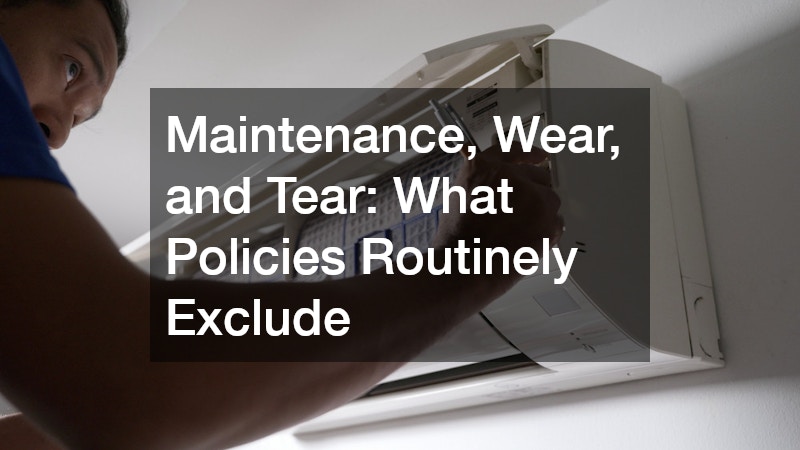
The most important thing for a homeowner to understand is that insurance is not a maintenance contract. Every policy explicitly excludes damage caused by “wear and tear,” “deterioration,” or “latent defects.” The responsibility for keeping the home’s systems in good working order lies solely with the owner.
A prime example is the home’s cooling system. If your air conditioner stops working in the middle of July because the compressor has simply reached the end of its life, your insurance will not pay for an AC repair service. However, if a fire starts in the garage and destroys the outdoor condenser unit, that would be a covered peril. Similarly, homeowners are expected to manage their own waste systems. A standard policy will not cover a septic system service required due to a lack of regular pumping or natural failure of the leach field.
Preventative measures are also excluded. While wood-destroying insects can cause thousands of dollars in structural damage, the cost of routine termite inspections and any subsequent pest control treatments are considered standard home maintenance costs. Failing to keep up with these tasks can lead to massive expenses that insurance will never touch.
Outdoor Structures, Trees, and Landscaping Coverage
Your policy doesn’t just cover the main house. “Other Structures” coverage (Coverage B) typically protects detached buildings such as a garden shed, a fence, or a detached garage. If a windstorm damages your garage door, it is generally covered under this section of the policy, provided the cause of loss was a covered peril.
Trees and landscaping are covered, but only for specific perils like fire, lightning, explosion, or vandalism—and usually only up to a certain dollar limit per plant. Wind and hail are often excluded when it comes to the plants themselves. When a tree falls during a storm, the insurance company will usually pay for its removal only if it lands on a covered structure, like your roof or your fence. If the tree simply falls in the middle of your yard without hitting anything, the cost of tree removal is usually an out-of-pocket expense. Moreover, insurance will never pay for proactive tree removal. If you have a dead oak tree leaning precariously over your house, the insurer expects you to remove it as part of your maintenance duties before it falls.
What to Expect When Contractors Enter the Picture
When you file a claim, the insurance company will often send an adjuster to evaluate the damage. They may suggest “preferred vendors”—contractors they have worked with before and who agree to the insurer’s pricing structures. While you are often free to hire your own contractors, there can be discrepancies in what the insurance company is willing to pay and what a private contractor charges.
In emergencies, such as a burst pipe at 2:00 AM, you are expected to take “reasonable steps” to prevent further damage. This might involve calling for emergency plumbing services to shut off the water and mitigate the immediate crisis. While the insurer will typically reimburse for the mitigation (like drying out the floors), they may only partially reimburse the actual repair of the pipe if they deem the plumber’s rates significantly higher than the local average.
For large-scale repairs, such as drying out a flooded basement or clearing massive debris, the cost of equipment rental for items like industrial dehumidifiers or wood chippers is often factored into the final claim settlement. It is vital to keep all receipts for these rentals, as they are part of the “reasonable and necessary” costs of restoring the property.
Filing a Claim the Right Way: Tips to Avoid Denials
The success of an insurance claim often depends on the homeowner’s actions immediately following the loss. Documentation is the most powerful tool you have. Take high-quality photos and videos of the damage from multiple angles before any cleanup or repairs begin. This provides the adjuster with a clear picture of the “before” and “after” state of the property.
Once the damage is documented and the emergency is stabilized, the next step is to get estimates. It is usually a good idea to get multiple quotes. For example, if your home needs a fresh coat of paint due to smoke damage, getting several quotes from reputable house painters ensures that the insurance company’s payout aligns with the actual market rates in your area. If the insurance company offers $3,000 but three different local contractors quote $5,000, you have the evidence needed to dispute the initial settlement.
Common mistakes that lead to rejected payouts include waiting too long to report a claim, discarding damaged items before the adjuster can see them, or performing permanent repairs before the inspection. By understanding the boundaries of your policy—knowing that it is there for catastrophes but not for routine maintenance—you can better manage your expectations and your finances. Regular upkeep, from checking for leaks to scheduling professional inspections, remains the best way to protect your home and ensure that when you truly need your insurance, it is ready to work for you.